MATH 308 — Lec 01 and Lec 02 — Sets I (Describing, Subsets, Operations)
Math 308 · September 4, 2026
Lecture 1 --- Sets I: Describing Sets, Subsets, and Set Operations MATH 308 Bridge to Advanced Mathematics Chartrand §1.1--1.4
Goals for today. By the end of this lecture you should be able to:
-
describe a set by roster and by set-builder notation, and use ∈,∈/ correctly;
-
name the standard number systems N,Z,Q,R and state the cardinality of a finite set;
-
decide when one set is a subset of another and write the power set of a small set;
-
compute unions, intersections, differences, and complements, and read a Venn diagram.
-
read an indexed family {Aα}α∈I and compute ⋃α∈IAα and ⋂α∈IAα
Describing a set (§1.1)
A set is a collection of objects, called its elements (or members). A set is completely determined by which objects belong to it --- not by order or repetition. We write x∈A for "x is an element of A" and x∈/A for its negation.
Example 1. Two ways to describe the same set.
-
Roster (list) notation: A={1,2,3,4,5}.
-
Set-builder notation: A={n∈N:1≤n≤5}, read "the set of n in N such that 1≤n≤5."
Order and repetition do not matter: {1,2,3}={3,1,2}={1,1,2,3}.
Standard number systems.
N={1,2,3,…},Z={…,−2,−1,0,1,2,…},Q={ba:a,b∈Z, b=0},R=the real numbers.(Whether 0∈N is a convention; in this course N starts at 1.)
Definition 1 (Empty set and cardinality). The empty set ∅={} is the set with no elements. For a finite set A, its cardinality ∣A∣ is the number of elements in A. Thus ∣∅∣=0 and ∣{1,2,3}∣=3.
Example 2. {x∈R:x2=−1}=∅, since no real number squares to −1. Note the difference between ∅ and {∅}: the latter has one element (namely ∅), so ∣{∅}∣=1.
Subsets (§1.2)
Definition 2. A is a subset of B, written A⊆B, if every element of A is also an element of B. If A⊆B but A=B, we call A a proper subset and write A⊂B.
This is our first "for all" statement, and it is the template for nearly every proof this term:
A⊆B⟺for every x, x∈A⇒x∈B.Proposition 1. For every set A: (i) ∅⊆A, and (ii) A⊆A.
Proof. (ii) is immediate. For (i), we must show x∈∅⇒x∈A for every x. There is no x with x∈∅, so the implication is vacuously true. (We will make "vacuously true" precise when we study logic.) ◻
Definition 3 (Set equality). A=B means A⊆B and B⊆A. This "double-containment" is the standard strategy for proving two sets are equal.
Definition 4 (Power set). The power set of A, written P(A), is the set of all subsets of A: P(A)={X:X⊆A}.
Example 3. For A={1,2},
P(A)={∅, {1}, {2}, {1,2}},∣P(A)∣=4.In general, if ∣A∣=n then ∣P(A)∣=2n --- a fact we will prove by induction later in the course.
Set operations (§1.3)
Fix sets A,B (thought of as living inside a universal set U when we take complements).
Definition 5.
A∪BA∩BA−BAc={x:x∈A or x∈B}={x:x∈A and x∈B}={x:x∈A and x∈/B}=U−A={x∈U:x∈/A}(union)(intersection)(difference)(complement)Sets A,B are disjoint if A∩B=∅.
Notation. The textbook writes A for the complement of A. We will write Ac instead, and reserve the overline A for the closure of a set, which you will meet when we study the real numbers.
Example 4. Let A={1,2,3,4} and B={3,4,5} with universe U={1,…,6}. Then
A∪B={1,2,3,4,5},A∩B={3,4},A−B={1,2},Ac={5,6}.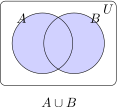
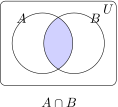
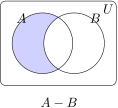
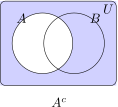
The basic set operations, shown by shading (inside the universe U).
A first taste of a set identity we will prove carefully once we have logic:
(A∪B)c=Ac∩Bc(one of De Morgan’s laws).Indexed collections of sets (§1.4)
Often we have not two or three sets but a whole family of them, one for each element of an index set I. We write {Aα}α∈I (read "the sets Aα, as α ranges over I"). Union and intersection extend naturally:
α∈I⋃Aα={x:x∈Aα for some α∈I},α∈I⋂Aα={x:x∈Aα for every α∈I}.Notice the quiet appearance of some and every --- exactly the quantifiers we take up next week.
Example 5. Let An=[0,n1] for each n∈N. Every An contains 0, and as n grows the intervals shrink toward {0}:
n∈N⋃An=[0,1],n∈N⋂An={0}.The intersection is not empty: 0 lies in every An; but no positive number does, since n1→0.
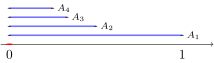
The nested intervals An=[0,n1] (top to bottom: A1,A2,A3,A4). Only 0 survives every one: ⋂nAn={0}.
Homework problems
-
Let R be the set of real numbers and let the symbols <, ≤ have their conventional meanings.
-
Show that
{x∈R:0≤x≤3}∪{x∈R:−1<x<1}={x∈R:0≤x<1}. -
List the elements of
{2,3,4}∪{x∈R:x2−4x+3=0}∩{x∈R:−1≤x<3}. -
Show that
{x∈R:−2≤x≤0}∪{x∈R:2<x<4}∩{x∈R:0≤x≤3}={x∈R:2<x≤3}∪{0}.
-
-
If A is a subset of the set S, show that
-
(AC)C=A
-
A∪A=A∩A=A∪∅=A
-
A∩∅=∅
-
-
Let A, B, C be subsets of a set S. Prove the following statements and illustrate them with Venn diagrams.
-
(A∪B)C=AC∩BC
-
A∩(B∪C)=(A∩B)∪(A∩C)
-
A∪(B∩C)=(A∪B)∩(A∪C).
-
-
If A, B, C are sets, show that
-
(A−B)∩C=(A∩C)−B
-
(A∪B)−(A∩B)=(A−B)∪(B−A)
-
A−(B−C)=(A−B)∪(A∩B∩C)
-
(A−B)×C=(A×C)−(B×C).
-
-
Let I be a nonempty set and for each i∈I let Xi be a set. Prove that
-
for any set B we have
B∩i∈I⋃Xi=i∈I⋃(B∩Xi) -
if each Xi is a subset of a given set S, then
(i∈I⋃Xi)C=i∈I⋂XiC.
-
Suggested textbook exercises (Chartrand §1.1--1.3): 1.2, 1.6, 1.14, 1.22, 1.30, 1.36.