MATH 308 — Lec 3 — Logic I (Statements & Implications)
Math 308 · September 11, 2026
Lecture 3 --- Logic I: Statements, Negation, and Implications MATH 308 Bridge to Advanced Mathematics Chartrand §2.1--2.5, 2.8
Goals for today. By the end of this lecture you should be able to:
-
decide whether a sentence is a statement and assign its truth value;
-
form and simplify the negation ∼P, and read a truth table;
-
build compound statements with ∧ (and), ∨ (or), ⇒ (implies), and know exactly when each is true;
-
write the converse, inverse, and contrapositive of an implication and say which are equivalent;
-
verify a logical equivalence by truth table, including the two De Morgan laws for logic.
Statements (§2.1)
A statement (or proposition) is a declarative sentence that is either true or false --- never both, and never neither. Its truth value is T (true) or F (false). Questions, commands, and opinions are not statements; neither is a sentence with a free variable until we pin the variable down.
Example 1. Statements: "7 is prime." (T), "2∈Q." (F), "∅⊆{1,2}." (T; recall Lecture 1, where this held vacuously). Not statements: "Is 10 even?" (a question), "Add 3 to x." (a command), "x2=4." (truth value undetermined until x is specified --- an open sentence, which we quantify in Lecture 4).
We name statements with letters P,Q,R,… and record all combinations of their truth values in a truth table. With n component statements there are 2n rows; for two statements P,Q we always list the rows in the order TT,TF,FT,FF.
Negation (§2.2)
Definition 1. The negation of a statement P is the statement "not P," denoted ∼P. Its truth value is always opposite to that of P.
PTF∼PFTThe art of negation is saying "not P" in plain language, not by bolting on "it is not the case that."
Example 2. P: "The integer 3 is odd." ∼P: "The integer 3 is even." Q: "r≤2." ∼Q: "r>2" (not "r≥2"). R: "Every side of the triangle is equal." ∼R: "Some side is unequal." The last one previews Lecture 4: negation turns "every" into "some."
Conjunction and disjunction (§2.3)
Definition 2. For statements P,Q:
-
the conjunction P∧Q ("P and Q") is true exactly when both are true;
-
the disjunction P∨Q ("P or Q") is true exactly when at least one is true.
The "or" of mathematics is inclusive: P∨Q is still true when both P and Q hold.
Example 3. Let P: "2∣6" (T) and Q: "5∣6" (F). Then P∧Q is false (not both), while P∨Q is true (at least one). Compare Lecture 1: x∈A∩B means (x∈A)∧(x∈B), and x∈A∪B means (x∈A)∨(x∈B). Set operations are logical connectives applied to membership.
The implication (§2.4)
The workhorse of the whole course is the implication.
Definition 3. For statements P (the hypothesis) and Q (the conclusion), the implication (or conditional) "if P, then Q" is denoted P⇒Q. It is false in exactly one case: when P is true but Q is false. In every other case it is true.
Here is the combined truth table for the three binary connectives.
PTTFFQTFTFP∧QTFFFP∨QTTTFP⇒QTFTTRemark 1. The last two rows unsettle everyone at first: how can "if P then Q" be true when P is false? Think of a promise: "If you get an A on the final, then you get an A in the course." The promise is broken only if you earn the A on the final and are still denied the grade (row 2). If you don't earn the A on the final (rows 3--4), the promise was never triggered, so it was not broken --- hence counted true. This is the same "vacuously true" idea behind ∅⊆A from Lecture 1.
The tie to sets is exact and worth stating. If P(x) and Q(x) are open sentences, then "P(x)⇒Q(x) for every x" says precisely {x:P(x)}⊆{x:Q(x)}: the hypothesis-region sits inside the conclusion-region.
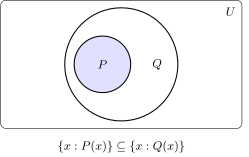
P⇒Q pictured with the truth-regions: everything that makes P true also makes Q true. ``Subset is implication in disguise'' (Lecture 1).
Converse, inverse, contrapositive
From one implication we can manufacture three relatives by swapping and/or negating.
Definition 4. For the implication P⇒Q:
converseQ⇒P,inverse(∼P)⇒(∼Q),contrapositive(∼Q)⇒(∼P).Example 4. P⇒Q: "If n is a multiple of 4, then n is even." (T)
-
Converse Q⇒P: "If n is even, then n is a multiple of 4." False (n=6).
-
Inverse (∼P)⇒(∼Q): "If n is not a multiple of 4, then n is odd." False (n=6).
-
Contrapositive (∼Q)⇒(∼P): "If n is odd, then n is not a multiple of 4." True.
Notice the original and its contrapositive share a truth value, and so do the converse and inverse. That is no accident.
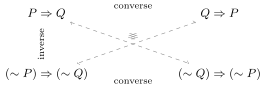
The four related conditionals. Diagonals are logically equivalent: an implication ≡ its contrapositive, and its converse ≡ its inverse.
Logical equivalence and De Morgan
Definition 5. Two compound statements R and S built from the same components are logically equivalent, written R≡S, if they have the same truth value in every row of the truth table.
Proposition 1 (Implication as "or"; and its contrapositive). *For all statements P,Q:
P⇒Q ≡ (∼P)∨Q,P⇒Q ≡ (∼Q)⇒(∼P).Proof. Build one truth table and compare columns.
PTTFFQTFTFP⇒QTFTT(∼P)∨QTFTT∼QFTFT(∼Q)⇒(∼P)TFTTThe columns for P⇒Q, (∼P)∨Q, and (∼Q)⇒(∼P) agree row by row, so all three are equivalent. ◻
This first equivalence has a striking consequence for negation: since P⇒Q≡(∼P)∨Q, negating an implication gives ∼(P⇒Q)≡P∧(∼Q) --- "the hypothesis holds but the conclusion fails." That single fact is the engine behind proof by contradiction (Lecture 9), and the contrapositive equivalence is what licenses proof by contrapositive (Lecture 5).
Theorem 2 (De Morgan's Laws for logic). *For all statements P,Q:
∼(P∨Q) ≡ (∼P)∧(∼Q),∼(P∧Q) ≡ (∼P)∨(∼Q).Proof. We verify the first law; the second is analogous.
PTTFFQTFTFP∨QTTTF∼(P∨Q)FFFT∼PFFTT(∼P)∧(∼Q)FFFTThe fourth and sixth columns match in every row, so ∼(P∨Q)≡(∼P)∧(∼Q). ◻
Remark 2. This is the same De Morgan we met for sets in Lecture 1, (A∪B)c=Ac∩Bc. Reading membership as truth --- x∈A is the statement P, x∈B is Q, and x∈Sc is ∼(x∈S) --- the set law is exactly the logic law applied pointwise. (We use Ac, never A; the overline is reserved for closure.) The two theorems are one theorem wearing two costumes.
In-class problems
-
Which are statements? Give the truth value of each that is. (a) "17 is even." (b) "Solve x+1=0." (c) "Q⊆R." (d) "n2≥0" (with n unspecified).
-
State a clean negation (no "it is not the case that"): (a) "x≥5." (b) "3 divides n and n is even." (c) "7 is prime or 8 is prime."
-
Build the full truth table for (∼P)∨Q and confirm it matches the column for P⇒Q.
-
For "If n2 is odd, then n is odd," write the converse, inverse, and contrapositive. Which of the four are true?
-
Use a truth table to verify the second De Morgan law ∼(P∧Q)≡(∼P)∨(∼Q), and connect it to (A∩B)c=Ac∪Bc from Lecture 1.
-
Show ∼(P⇒Q)≡P∧(∼Q) by a truth table, and state in words what it means for the implication "If it rains, then the game is cancelled" to be false.
Suggested textbook exercises (Chartrand §2.1--2.5, 2.8): 2.1, 2.4, 2.11, 2.13, 2.19, 2.24, 2.30, 2.36.