MATH 308 — Lec 10 — Counterexamples & Uniqueness
Math 308 · October 15, 2026
Lecture 10 — Counterexamples and Uniqueness
MATH 308 Bridge to Advanced Mathematics Chartrand §5.1, 5.4
Goals for today. By the end of this lecture you should be able to:
-
disprove a universally quantified statement by exhibiting a single counterexample;
-
write the logical shape of a disproof as the negation ∼(∀x,P(x))≡∃x,∼P(x);
-
recognize that a pattern verified in many cases is not a proof, and hunt for the case that breaks it;
-
prove a uniqueness statement by assuming two objects with the property and deducing they are equal.
Disproof by counterexample (§5.1)
Most theorems in this course are universally quantified: they claim “for every x in some set, P(x) holds.” To prove such a statement we must argue about an arbitrary x (Lecture 5). To disprove it, we need much less — a single offending instance.
Recall from Lecture 4 how the negation of a quantified statement is formed:
∼(∀x∈S, P(x))≡∃x∈S, ∼P(x).So to show “∀x∈S, P(x)” is false, we prove its negation “∃x∈S, ∼P(x)” — and an existence statement is settled by producing one witness (Lecture 9).
Definition 1. A counterexample to the statement “for every x∈S, P(x)” is a single element x0∈S for which P(x0) is false. One counterexample disproves the statement completely.
Example 1. Claim: “Every prime number is odd.” Counterexample: 2 is prime and even. One number ends the discussion — the claim is false. (Note 2 is the only counterexample; it takes just one.)
Example 2. Claim: “For every real number x, x2≥x.” This looks plausible: it holds for x=2 (4≥2), for x=5, for every x≥1, and for every x≤0. But take
x0=21:x02=41 ≥ 21=x0.So x0=21 is a counterexample and the claim is false. The inequality fails exactly on the open interval (0,1), where the parabola dips below the line (Figure [fig:x2]).
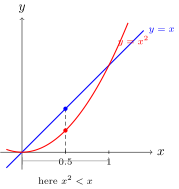
On (0,1) the parabola y=x2 lies below the line y=x, so x2≥x fails there. The witness x0=21 suffices to disprove the universal claim.
A verified pattern is not a proof. The danger is subtler when a claim survives many test cases. Checking a hundred — or a million — instances establishes nothing about the infinitely many you did not check. The next result is the classic warning.
Proposition 1. The statement “for every n∈N with n≥1, the number n2+n+41 is prime” is false.
Proof. The expression n2+n+41 is genuinely prime for n=1,2,3,…,39 (a striking run worth checking for a few small n). Nevertheless it is not always prime. Take n0=40:
402+40+41=1600+40+41=1681=41×41=412,which is composite. Thus n0=40 is a counterexample, and the universal claim is false. ◻
Remark 1. Notice why the counterexample was inevitable: n2+n+41 at n=41 is 41(41+1+1), plainly divisible by 41, and n=40 fails for the same structural reason. When a pattern begs to be believed, look for the hidden algebraic reason it must eventually break — do not trust the streak.
Proving uniqueness (§5.4)
Many theorems assert not just that an object with a certain property exists, but that there is exactly one. “Exactly one” splits into two claims:
existence (Lecture 9)at least oneanduniquenessat most one.Existence we prove by exhibiting a witness. Uniqueness has its own standard template.
Definition 2 (Uniqueness argument). To prove there is at most one object with property P: assume x and y both have property P, and deduce x=y. Combined with an existence proof, this establishes “there exists a unique object with property P,” written ∃!x, P(x).
Example 3. Claim: there is a unique real number x with x+3=7. Existence: x=4 works. Uniqueness: if x+3=7 and y+3=7, then x+3=y+3, and subtracting 3 gives x=y. So the solution is unique.
The next theorem is the linear-equation version, and its uniqueness half is the model argument to imitate.
Theorem 2. Let a,b∈R with a=0. Then there is a unique real number x with ax=b.
Proof. Existence. Since a=0, the number x=b/a is defined, and a⋅(b/a)=b. So at least one solution exists.
Uniqueness. Suppose x1 and x2 both satisfy the equation, so ax1=b and ax2=b. Then ax1=ax2, hence a(x1−x2)=0. Because a=0, we may divide by a to get x1−x2=0, i.e. x1=x2. Thus at most one solution exists.
Existence and uniqueness together give exactly one solution, namely x=b/a. ◻
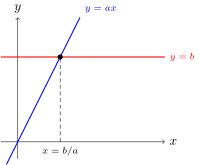
Geometry of uniqueness: the line y=ax (slope a=0) meets the horizontal line y=b in exactly one point. Two solutions would force the same line to cross y=b twice — impossible for a non-horizontal line.
A uniqueness argument shines when there is no formula to point at — when the object is defined only by its property. The additive identity of R is the cleanest instance.
Proposition 3. The real numbers have a unique additive identity: there is exactly one e∈R with x+e=x for every x∈R.
Proof. Existence. e=0 satisfies x+0=x for all x.
Uniqueness. Suppose e and e′ are both additive identities. Using that e′ is an identity, e+e′=e. Using that e is an identity, e+e′=e′. Reading the same quantity two ways,
e=e+e′=e′.Hence e=e′, so the identity is unique. ◻
Remark 2. The trick — evaluate one expression, here e+e′, in two ways, once via each hypothesis — is the heart of most uniqueness proofs in algebra. We meet it again when we prove that a bijection has a unique inverse function in Lecture 17.
Homework problems
-
Disprove: “For every n∈N, 2n−1 is prime.” Give the smallest counterexample and justify it.
-
Disprove: “For all real x and y, x2+y2=x+y.” State the negation as an existence statement, then produce a witness.
-
True or false, with a proof or a counterexample: “For every n∈Z, if n2 is even then n is even.”
-
Prove there is a unique real number x with 5x−2=13: show existence, then run the uniqueness template.
-
Let a∈R be nonzero. Prove a has a unique multiplicative inverse: exactly one y∈R with ay=1. (Mimic the identity proof.)
-
Find a statement “∀n∈N, P(n)” that is true for n=1,…,5 but false for some larger n, and name the counterexample.
Suggested textbook exercises (Chartrand §5.1, 5.4): 5.20, 5.24, 5.28, 5.32, 5.36, 5.40.