MATH 308 — Lec 5 — Direct Proof & Contrapositive
Math 308 · September 18, 2026
Lecture 5 — Direct Proof and Proof by Contrapositive
MATH 308 Bridge to Advanced Mathematics Chartrand §3.1–3.3
Goals for today. By the end of this lecture you should be able to:
-
state precisely what it means for an integer to be even or odd, and use those definitions inside a proof;
-
write a direct proof of an implication “if P then Q” — assume P, reason forward, arrive at Q;
-
recognize when a direct attack stalls and switch to the contrapositive (∼Q⇒∼P), and say why that is legitimate;
-
prove statements about parity, including the flagship result: if n2 is even then n is even.
The setting: even and odd integers (§3.1)
Before we can prove anything, we need statements built from precise definitions. Almost every example this week lives in the integers, sorted by parity.
Definition 1. An integer n is even if n=2k for some k∈Z, and odd if n=2k+1 for some k∈Z. Two integers have the same parity if both are even or both are odd; otherwise they have opposite parity.
That every integer is either even or odd (and never both) is exactly the partition Z=E∪O we met in Lecture 2. We will use that fact freely today and prove it cleanly once we have the Division Algorithm in Lecture 7.

Parity partitions Z: even integers (filled) and odd integers (open) strictly alternate. “n=2k” picks out the filled dots; “n=2k+1” the open ones.
The anatomy of a direct proof
Most theorems have the form of an implication, P⇒Q (Lecture 3): a hypothesis P we are allowed to assume, and a conclusion Q we must reach. A direct proof does the obvious thing.
Direct proof of P⇒Q: Assume P is true. Using P, definitions, and facts already known, reason forward until you deduce Q.
We never have to worry about the case where P is false: an implication with a false hypothesis is automatically true (recall the vacuous truth of ∅⊆A from Lecture 1). So the only work is the case P true, and the whole game is to unwind the definition of P, do some algebra, and repackage the result as Q.

The shape of a direct proof: enter on the left with P, flow rightward, exit with Q. Every step is forced by what came before.
Proposition 1. If m and n are even integers, then m+n is even.
Proof. Assume m and n are even. By definition there are integers j,k with m=2j and n=2k. Then
m+n=2j+2k=2(j+k).Since j+k∈Z, the number m+n has the form 2(integer), so m+n is even. ◻
Notice the rhythm: name the integers the hypothesis promises (j,k), compute, then recognize the target form 2(⋅). Watch the same three beats in a mixed-parity statement.
Proposition 2. If n is an odd integer, then 3n+7 is even.
Proof. Assume n is odd, so n=2k+1 for some k∈Z. Then
3n+7=3(2k+1)+7=6k+3+7=6k+10=2(3k+5).As 3k+5∈Z, we conclude 3n+7 is even. ◻
The single most useful direct proof of the week is the one that later powers the contrapositive method. Keep it close.
Proposition 3. If n is an odd integer, then n2 is odd.
Proof. Assume n is odd, so n=2k+1 for some k∈Z. Then
n2=(2k+1)2=4k2+4k+1=2(2k2+2k)+1.Since 2k2+2k∈Z, the integer n2 has the form 2(integer)+1, hence is odd. ◻
Remark 1. Two degenerate but honest proof shapes round out §3.1. A trivial proof of P⇒Q establishes Q outright, ignoring P (e.g. “if n>0 then n2+1>0” — the conclusion holds for every integer). A vacuous proof observes that P is never true, so P⇒Q holds with nothing to check (e.g. “if n2<0 then n=17”). Both are reminders that the truth of P⇒Q tracks the truth table of Lecture 3, not any real “cause and effect.”
Proof by contrapositive (§3.2)
Sometimes a direct proof stalls. Consider: if n2 is even then n is even. Assuming the hypothesis gives n2=2k, i.e. n=2k — a dead end, because a square root drags us out of the integers and tells us nothing about the parity of n. The hypothesis is about n2, but the leverage we want is about n.
The fix rests on a single logical equivalence you verified by truth table in Lecture 3:
(P⇒Q)≡(∼Q⇒∼P).The right-hand statement is the contrapositive. Because the two are logically equivalent — true in exactly the same rows — proving either one proves the other. (Do not confuse this with the converse Q⇒P, which is a genuinely different claim.)
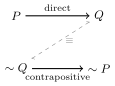
Left: a statement and its contrapositive are two names for the same arrow. Right: identical truth-table columns — why proving one proves the other.
Proof by contrapositive of P⇒Q: Assume ∼Q. Reason forward (a direct proof again!) until you deduce ∼P.
When to reach for it. Switch to the contrapositive when the negations are friendlier than the originals — typically when Q is the simple, factorable statement (“n is even”) and P is the awkward one (“n2 is even”). Negating swaps their roles and hands you the tractable hypothesis.
Theorem 4. Let n∈Z. If n2 is even, then n is even.
Proof. We prove the contrapositive: if n is odd, then n2 is odd. But that is exactly Proposition 3: writing n=2k+1 gives n2=2(2k2+2k)+1, which is odd. Hence the original implication holds. ◻
The awkward hypothesis “n2 is even” never had to be unwound: negating the conclusion handed us the clean, factorable “n is odd” to start from instead. That is the whole payoff.
Proposition 5. Let n∈Z. If 5n+8 is odd, then n is odd.
Proof. Contrapositive: assume n is even, say n=2k with k∈Z. Then
5n+8=5(2k)+8=10k+8=2(5k+4),which is even. So “n even” forces “5n+8 even,” i.e. ∼Q⇒∼P; equivalently, if 5n+8 is odd then n is odd. ◻
Remark 2. Theorem 4 is not a curiosity — it is the crucial lemma in the classic proof that 2 is irrational, which we will give (by contradiction) in Lecture 9. There, “n2 even ⇒ n even” is applied twice to force a shared factor of 2 and detonate the argument.
Homework Problems
-
Prove directly: if m is even and n is odd, then m+n is odd.
-
Prove directly: if n is an odd integer, then n2+3n+5 is odd. (Watch the parity of each term.)
-
State the contrapositive and the converse of “if n2 is odd, then n is odd.” Prove the true one; give a value of n making the converse’s status clear.
-
Prove by contrapositive: for n∈Z, if 7n−5 is even, then n is odd.
-
Prove by contrapositive: for a,b∈Z, if ab is odd, then both a and b are odd. (Negation of “both odd” is “at least one is even” — Lecture 4.)
-
Which shape — direct or contrapositive — fits “if n3 is even, then n is even”? Carry it out.
Suggested textbook exercises (Chartrand §3.1–3.3): 3.2, 3.6, 3.10, 3.14, 3.18, 3.22, 3.28.