MATH 308 — Lec 13 — Relations
Math 308 · October 23, 2026
Lecture 13 — Relations
MATH 308 Bridge to Advanced Mathematics Chartrand §9.1–9.2
Goals for today. By the end of this lecture you should be able to:
-
state that a relation from A to B is a subset R⊆A×B, and use the notation aRb;
-
write a given relation as an explicit set of ordered pairs and draw it (arrow diagram, grid);
-
define reflexive, symmetric, and transitive for a relation on a set;
-
prove or disprove that a specific relation has each property — a universal claim by argument, its failure by one counterexample.
The prove-or-disprove mindset (Ch. 8)
Chapter 8 hands you a statement and asks a sharper question than “prove it”: it asks you to first decide whether it is true. This is the working stance for everything below.
-
To establish a universal claim (“for all x …”), you must argue for an arbitrary element — one counterexample is fatal, so you cannot check cases.
-
To disprove a universal claim, you need exactly one counterexample: a single x where it fails.
Every property of relations in §3 is a universal statement, so each one is a little prove-or-disprove problem. Keep both moves — argue-for-all, or exhibit-one — in the same hand.
Relations (§9.1)
Recall from Lecture 2 that the Cartesian product A×B={(a,b):a∈A, b∈B} collects all ordered pairs. A relation simply selects some of them: the pairs that “are related.”
Definition 1. A relation R from a set A to a set B is a subset R⊆A×B. We write
aRbto mean(a,b)∈R,andaRb to mean (a,b)∈/R.When A=B we call R a relation on A; then R⊆A×A.
Nothing here is new machinery: a relation is a subset (Lecture 1) of a product (Lecture 2). Everything else is vocabulary laid on top of that one idea.
Example 1. Let A={1,2,3} and B={a,b,c}, and let
R={(1,a), (1,c), (2,b), (3,b)} ⊆ A×B.Then 1Ra and 2Rb are true, while 2Ra (the pair (2,a) is not in R). There are ∣A×B∣=3⋅3=9 possible pairs; R chose 4 of them. In fact any of the 29 subsets of A×B is a legal relation — most have no tidy description at all.
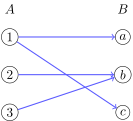
The relation R={(1,a),(1,c),(2,b),(3,b)} as an arrow diagram: draw a→b exactly when aRb. A relation is its set of arrows.
Example 2 (Relations you already know). Each of these is a relation on a familiar set, i.e. a subset of a square product.
“≤” on R: {(x,y):x≤y}⊆R2,“divides” on N: {(a,b):a∣b}⊆N2.Recall a∣b (Lecture 7) means b=ak for some k∈Z. So 2∣6 gives 2R6, while 4∣6 gives 4R6.
Properties of a relation on a set
Fix a relation R on a set A. The three properties below are the vocabulary that organizes all of Chapter 9. Notice the quantifiers (Lecture 3–4): each is a “for all” statement.
Definition 2. The relation R on A is
-
reflexive if xRx for every x∈A;
-
symmetric if xRy⇒yRx for all x,y∈A;
-
transitive if (xRy and yRz)⇒xRz for all x,y,z∈A.
It pays to see these on the grid A×A, exactly the picture of a Cartesian product from Lecture 2. Plot a dot at (x,y) precisely when xRy. Then reflexive means the relation contains the whole diagonal, and symmetric means the picture is unchanged when reflected across that diagonal.
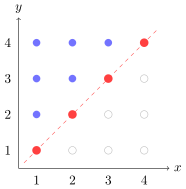
The relation “≤” on {1,2,3,4} as a subset of the grid {1,2,3,4}2. Red = the diagonal (xRx): every diagonal cell is present, so ≤ is reflexive. Blue = strictly above. The open cells below the diagonal are missing, so the picture is not symmetric about the diagonal — ≤ is not symmetric.
Example 3 (Concrete first). Let A={1,2,3} and let R={(x,y)∈A2:x+y is even}. Listing the pairs,
R={(1,1),(1,3),(2,2),(3,1),(3,3)}.Reflexive? Yes: x+x=2x is even, so (x,x)∈R for every x. Symmetric? Yes: x+y=y+x, so x+y even ⇔y+x even. Transitive? Yes: if x+y and y+z are both even then their sum x+2y+z is even, hence x+z=(x+2y+z)−2y is even. This relation is really “x and y have the same parity” — the partition of Z into evens and odds from Lecture 2, now seen as a relation. Such all-three relations are equivalence relations, the whole topic of Lecture 14.
Example 4 (Non-examples, via one counterexample each). Take the relation “<” on Z.
-
Not reflexive: 1<1 is false, so (1,1)∈/<. One witness kills the “for all.”
-
Not symmetric: 1<2 but 2<1.
-
Transitive: this one is true — but now we owe an argument, not an example: if x<y and y<z then x<z for all integers.
So “<” is transitive only; “divides” below is reflexive and transitive but not symmetric. Different relations sit in different boxes — that is the point of having names.
Proposition 1. The relation “divides” on N, namely R={(a,b)∈N2:a∣b}, is reflexive and transitive, but not symmetric.
Proof. Reflexive. Let a∈N be arbitrary. Since a=a⋅1, we have a∣a, so (a,a)∈R. As a was arbitrary, R is reflexive.
Transitive. Let a,b,c∈N with a∣b and b∣c. Then b=ak and c=bℓ for some k,ℓ∈Z. Substituting, c=(ak)ℓ=a(kℓ), and kℓ∈Z, so a∣c. Hence R is transitive.
Not symmetric. We disprove the universal claim with one counterexample: 2∣4, so (2,4)∈R, but 4∤2, so (4,2)∈/R. Thus R is not symmetric. ◻
Remark 1. A property can fail in one direction and hold in another — “divides” is reflexive but not symmetric — so you must check each of the three separately. They are independent questions about the same subset of A×A.
Homework
-
Let A={2,3,4} and B={4,6,9,12}. Write the relation “a divides b” from A to B as an explicit set of ordered pairs, and draw its arrow diagram.
-
On A={1,2,3,4} define xRy iff x−y is even. List the pairs of R, then decide (with proof or counterexample) whether R is reflexive, symmetric, transitive.
-
Prove or disprove each property (reflexive, symmetric, transitive) for the relation “≤” on Z.
-
Draw the grid picture (the subset of A×A) for the relation “≤” on A={1,2,3}. Which cells encode reflexivity? Which reflection encodes symmetry?
-
Give a relation on {1,2,3} that is symmetric but not transitive, and a different one that is reflexive and transitive but not symmetric. (One counterexample settles each “not.”)
Suggested textbook exercises (Chartrand §9.1): 9.2, 9.4, 9.6, 9.10, 9.14, 9.18.