MATH 308 — Lec 11 — Mathematical Induction
Math 308 · October 15, 2026
Lecture 11 — Mathematical Induction
MATH 308 Bridge to Advanced Mathematics Chartrand §6.1–6.2
Goals for today. By the end of this lecture you should be able to:
-
state the Principle of Mathematical Induction and explain the domino/ladder intuition behind it;
-
structure an induction proof into a base case and an inductive step, naming the inductive hypothesis;
-
prove a summation formula, a divisibility fact, and an inequality by induction;
-
prove ∣P(A)∣=2n for a set with n elements — the fact we promised back in Lecture 1.
The Principle of Mathematical Induction (§6.1)
Suppose we have, for each n∈N, a statement P(n) — one claim per natural number. For example, “P(n): the sum of the first n odd numbers is n2.” We want to prove that all of P(1),P(2),P(3),… are true. We cannot check infinitely many statements one at a time. Induction gives us a way to capture them all with two finite checks.
The picture to keep in mind is a row of dominoes, or the rungs of an infinite ladder. To knock down every domino it is enough to know two things: (1) the first one falls, and (2) whenever one falls, it topples the next. Then domino 1 falls, so domino 2 falls, so domino 3 falls, … — and no domino is left standing.
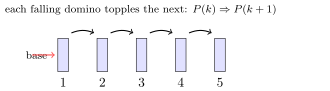
Induction as falling dominoes: push the first (base case) and guarantee each topples its successor (inductive step); then every domino falls.
Theorem 1 (Principle of Mathematical Induction, PMI). Let P(n) be a statement for each n∈N. Suppose:
-
(base case) P(1) is true; and
-
(inductive step) for every k∈N, if P(k) is true then P(k+1) is true.
Then P(n) is true for every n∈N.
The assumption “P(k) is true” that we get to use inside the inductive step has a name: the inductive hypothesis. The whole art of an induction proof is to start from the case k and reduce the case k+1 back to it.
Remark 1. Induction need not start at 1. If the base case is proved at some integer n0 (possibly 0 or negative) and the inductive step runs for all k≥n0, then P(n) holds for all integers n≥n0. We use n0=0 in Theorem 5 below.
A summation formula (§6.1)
Proposition 2. *For every n∈N,
1+2+3+⋯+n=2n(n+1).Proof. Let P(n) be the displayed equation.
Base case (n=1): the left side is 1 and the right side is 21⋅2=1. So P(1) holds.
Inductive step: fix k∈N and assume P(k): that 1+2+⋯+k=2k(k+1) (this is the inductive hypothesis). We must deduce P(k+1). Adding k+1 to both sides,
=2k(k+1)1+2+⋯+k+(k+1)=2k(k+1)+(k+1)=(k+1)(2k+1)=2(k+1)(k+2).The last expression is exactly the right-hand side of P(k+1) (namely 2(k+1)((k+1)+1)). Thus P(k)⇒P(k+1). By the PMI, P(n) holds for all n∈N. ◻
There is also a wordless reason this formula is true. Take two copies of the staircase 1+2+⋯+n and fit them together into an n×(n+1) rectangle of dots. The rectangle has n(n+1) dots, so one staircase has half that.
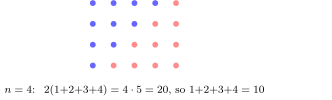
Two staircases (blue =1+2+3+4, red its mirror) tile a 4×5 grid: 2∑i=1ni=n(n+1).
A divisibility result (§6.2)
Recall from Lecture 7 that d∣m (“d divides m”) means m=dq for some integer q.
Proposition 3. For every n∈N, 3∣(4n−1).
Proof. Let P(n) be the statement “3∣(4n−1).”
Base case (n=1): 41−1=3=3⋅1, so 3∣(41−1) and P(1) holds.
Inductive step: fix k∈N and assume P(k), i.e. 4k−1=3q for some q∈Z. Then
4k+1−1=4⋅4k−1=4(4k−1)+3=4(3q)+3=3(4q+1).Since 4q+1∈Z, this shows 3∣(4k+1−1), which is P(k+1). By the PMI, P(n) holds for all n∈N. ◻
The trick to spot: rewrite the “k+1” quantity so that the “k” quantity (which the hypothesis controls) appears explicitly, with the leftover being visibly a multiple of 3. That single algebraic move — 4⋅4k−1=4(4k−1)+3 — is the entire inductive step.
An inequality (§6.2)
Proposition 4. For every n∈N, 2n>n.
Proof. Let P(n) be “2n>n.”
Base case (n=1): 21=2>1, so P(1) holds.
Inductive step: fix k∈N and assume P(k): 2k>k. Then, doubling,
2k+1=2⋅2k>2k=k+k≥k+1,where the last step uses k≥1. Hence 2k+1>k+1, which is P(k+1). By the PMI, 2n>n for all n∈N. ◻
Remark 2. Notice we used k≥1 to turn 2k into “at least k+1.” Inequalities often need such slack from the domain; keeping the strict “>” through the chain is what delivers a strict conclusion.
The size of a power set
We can finally settle a claim left open in Lecture 1: a set with n elements has exactly 2n subsets.
Theorem 5. If A is a finite set with ∣A∣=n, then ∣P(A)∣=2n.
Proof. We induct on n=∣A∣, starting the base case at n=0. Let P(n) be: “every set with n elements has exactly 2n subsets.”
Base case (n=0): the only set with 0 elements is ∅, and its only subset is ∅ itself, so P(∅)={∅} and ∣P(∅)∣=1=20. Thus P(0) holds.
Inductive step: fix k≥0 and assume P(k): every k-element set has 2k subsets. Let A be any set with ∣A∣=k+1. Pick one element a∈A and set A′=A−{a}, so ∣A′∣=k. Now split the subsets of A into two kinds:
-
those that do not contain a: these are exactly the subsets of A′, and there are 2k of them by the inductive hypothesis;
-
those that do contain a: each is of the form X∪{a} for a unique X⊆A′, so there are again 2k of them.
Every subset of A is of exactly one kind (it either omits a or contains it), so these two families are disjoint and together exhaust P(A). Therefore
∣P(A)∣=2k+2k=2⋅2k=2k+1,which is P(k+1). By the PMI, ∣P(A)∣=2∣A∣ for every finite set A. ◻
The doubling “2k+2k=2k+1” is the heart of it: adding one new element a to a set gives every old subset a choice — take a or leave it — so the number of subsets doubles at each step.
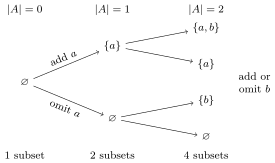
Building P(A) by adding one element at a time. Each new element doubles the count: 1→2→4=22 for A={a,b}.
Remark 3. Two common pitfalls. (1) No base case. A valid inductive step alone proves nothing: dominoes that each topple the next still all stand if none is pushed. (2) Using what you’re proving. In the inductive step you may assume only P(k), never P(k+1) — that would be assuming the conclusion. We sharpen the hypothesis (assume all of P(1),…,P(k)) in strong induction, Lecture 12.
Homework problems
-
Prove by induction that 1+3+5+⋯+(2n−1)=n2 for all n∈N.
-
Prove that 3∣(n3−n) for all n∈N. (Rewrite (k+1)3−(k+1) so that k3−k appears.)
-
Prove that i=1∑ni2=6n(n+1)(2n+1) for all n∈N.
-
For which n∈N is 2n>n2? Make a conjecture from small cases, then prove it by induction (mind the base case).
-
Where exactly does the “proof” that all horses are the same color break down? (It inducts on the size of a set of horses.) Which step fails, and for which k?
Suggested textbook exercises (Chartrand §6.1–6.2): 6.2, 6.6, 6.10, 6.14, 6.20, 6.26.