MATH 308 — Lec 6 — Proof by Cases; Biconditionals
Math 308 · September 24, 2026
Lecture 6 — Proof by Cases and Biconditionals
MATH 308 Bridge to Advanced Mathematics Chartrand §2.6, 3.4
Goals for today. By the end of this lecture you should be able to:
-
split a proof into exhaustive cases and know why the cases together settle the whole statement;
-
use “same/opposite parity” and the phrase without loss of generality correctly;
-
read the biconditional P⇔Q as two implications and prove each direction;
-
recognize an “if and only if” theorem as a characterization — an exact substitute for a condition.
Proof by cases (§3.4)
Sometimes a statement about every x in a set S is hard to attack all at once, but easy once we know a little more about x. If the possibilities for x can be sorted into finitely many cases that cover every element of S, and the statement holds in each case, then it holds for all of S. This is proof by cases.
The one non-negotiable requirement is that the cases be exhaustive: every x∈S must fall into at least one case. (Overlap between cases is harmless; a gap is fatal.) The most common split is by parity — recall from Lecture 2 that {E,O}, the even and odd integers, is a partition of Z, so “n even” and “n odd” are automatically exhaustive.
Example 1 (The workhorse example). For every n∈Z, the product n(n+1) is even.
Proof. We consider two cases according to the parity of n.
-
Case 1: n is even. Then n=2k for some k∈Z, so n(n+1)=2k(n+1)=2(k(n+1)). Since k(n+1)∈Z, the product is even.
-
Case 2: n is odd. Then n+1 is even, say n+1=2k with k∈Z, so n(n+1)=2kn=2(kn). Since kn∈Z, the product is even.
In both cases n(n+1) is even, and the two cases exhaust Z. ■
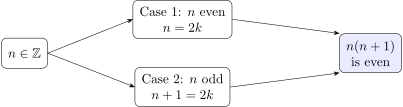
Proof by cases: the exhaustive split of Z into even and odd integers. Every path leads to the same conclusion, so the conclusion holds for all n∈Z.
Proposition 1. For every n∈Z, the integer n2+3n+5 is odd.
Proof. We proceed by cases on the parity of n.
Case 1: n is even. Write n=2a with a∈Z. Then
n2+3n+5=4a2+6a+5=2(2a2+3a+2)+1.Since 2a2+3a+2∈Z, the value is odd.
Case 2: n is odd. Write n=2a+1 with a∈Z. Then
n2+3n+5=(2a+1)2+3(2a+1)+5=4a2+10a+9=2(2a2+5a+4)+1.Since 2a2+5a+4∈Z, the value is odd. In both cases the value is odd. ◻
Definition 1 (Same / opposite parity). Integers x and y are of the same parity if they are both even or both odd; they are of opposite parity if one is even and the other odd. For instance 5 and 13 have the same parity, while 8 and 11 have opposite parity.
Any statement phrased with “same parity” is a natural candidate for proof by cases, because the hypothesis already hands you the case split.
Remark 1 (Without loss of generality). When two cases have proofs that differ only by swapping the names of the objects, it is wasteful to write both. We say “without loss of generality (WLOG), assume x is even and y is odd,” handle that case, and note the other is identical after relabeling. Use WLOG only when the swap really does turn one proof into the other — never to skip a genuinely different case.
The biconditional: “if and only if” (§3.4–3.5)
Recall from Lecture 3 that the implication P⇒Q (“if P then Q”) can be true while its converse Q⇒P is false. When both hold, P and Q stand or fall together, and we write P⇔Q, read “P if and only if Q” (often abbreviated “iff”).
Definition 2 (Biconditional). The biconditional P⇔Q is the statement (P⇒Q)∧(Q⇒P). It is true exactly when P and Q have the same truth value.
| P | Q | P⇒Q | Q⇒P | P⇔Q |
|---|---|---|---|---|
| T | T | T | T | T |
| T | F | F | T | F |
| F | T | T | F | F |
| F | F | T | T | T |
The last column agrees with the third and fourth exactly where both are T. So to prove a biconditional you must prove two implications: the forward direction P⇒Q (⇒) and the converse Q⇒P (⇐). Each is proved by whatever method fits — direct, contrapositive (Lecture 5), or cases — and the two directions may well use different methods.
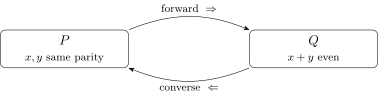
A biconditional P⇔Q is two implications. Proving it means walking both arrows; neither direction alone suffices.
Theorem 2 (Same parity, characterized). Let x,y∈Z. Then x and y are of the same parity if and only if x+y is even.
Proof. (⇒) Assume x and y have the same parity. We consider two cases.
Case 1: both even. Then x=2a and y=2b for some a,b∈Z, so x+y=2(a+b) is even.
Case 2: both odd. Then x=2a+1 and y=2b+1 for some a,b∈Z, so x+y=2a+2b+2=2(a+b+1) is even.
In either case x+y is even.
(⇐) We prove the contrapositive: if x and y have opposite parity, then x+y is odd. Without loss of generality assume x is even and y is odd, say x=2a and y=2b+1 with a,b∈Z. Then
x+y=2a+2b+1=2(a+b)+1,which is odd. Hence if x+y is even, x and y cannot have opposite parity, so they have the same parity. ◻
Notice how the two directions used different tools: the forward direction was a direct proof by cases, the converse a proof by contrapositive that itself used WLOG. This is typical.
Theorem 3. Let a,b∈Z. Then ab is even if and only if a is even or b is even.
Proof. (⇐) Assume a is even or b is even. Without loss of generality let a be even, say a=2x with x∈Z. Then ab=2(xb), and since xb∈Z, ab is even.
(⇒) We prove the contrapositive: if it is not the case that a is even or b is even, then ab is odd. By one of De Morgan’s laws (Lecture 3), the negation of “a is even or b is even” is “a is odd and b is odd.” So write a=2x+1 and b=2y+1 with x,y∈Z. Then
ab=(2x+1)(2y+1)=4xy+2x+2y+1=2(2xy+x+y)+1,which is odd. Contrapositively, if ab is even then a is even or b is even. ◻
Remark 2 (On §3.5, evaluating proofs). Chartrand §3.5 asks you to read a written argument and judge it: Are the cases exhaustive? Is each implication of a biconditional actually proved, or only one direction? Is a “WLOG” honest? Reading proofs critically is the same skill as writing them — and both directions of an “iff” must be present before a proof is complete.
In-class problems
-
Prove by cases that for every n∈Z, the integer n2−3n+9 is odd.
-
Prove that for every n∈Z, the integer n3−n is even. (Hint: n3−n=(n−1)n(n+1); use the workhorse example, or three cases mod 3.)
-
Let x,y∈Z. Prove that x−y is even if and only if x and y have the same parity. Which theorem above does this resemble, and why?
-
Let a,b∈Z. Prove that ab is odd if and only if a and b are both odd. (Relate it to Theorem 2.2 by negation.)
-
State the converse of “if n is a multiple of 4, then n is even.” Is the biconditional true? Give a proof or a counterexample.
-
A student proves “x+y is even ⇒ x,y same parity” and stops. Have they proved the biconditional in Theorem 2.1? Explain what is missing.
Suggested textbook exercises (Chartrand §3.4–3.5): 3.26, 3.27, 3.28, 3.30, 3.32, 3.37, 3.41, 3.44.