MATH 308 — Lec 14 — Equivalence Relations
Math 308 · October 23, 2026
Lecture 14 — Equivalence Relations and Equivalence Classes
MATH 308 Bridge to Advanced Mathematics Chartrand §9.3–9.4
Goals for today. By the end of this lecture you should be able to:
-
check whether a relation is reflexive, symmetric, and transitive, and so decide whether it is an equivalence relation;
-
compute the equivalence class [a] of an element and list the distinct classes;
-
state and prove the Fundamental Theorem: the equivalence classes of an equivalence relation on S form a partition of S, and conversely every partition arises this way;
-
recognize equivalence as “sameness up to something” across the rest of mathematics.
Equivalence relations (§9.2)
Recall from Lecture 13 that a relation R on a set S is just a subset R⊆S×S; we write aRb to mean (a,b)∈R. Three properties of a relation will matter today.
Definition 1. A relation R on a set S is
-
reflexive if aRa for every a∈S;
-
symmetric if aRb⇒bRa for all a,b∈S;
-
transitive if (aRb and bRc)⇒aRc for all a,b,c∈S.
An equivalence relation is a relation that is reflexive, symmetric, and transitive. When R is an equivalence relation we usually write a∼b in place of aRb, read “a is equivalent to b.”
The three axioms are exactly the properties of the most familiar relation of all — equality. “a=a” (reflexive), “a=b forces b=a” (symmetric), “a=b and b=c force a=c” (transitive). An equivalence relation is what you get when you keep these three rules but relax “identical” to “the same in some chosen respect.”
Example 1 (The seed from Lecture 2: same parity). Define a∼b on Z to mean a and b have the same parity (both even or both odd). This is an equivalence relation:
-
Reflexive: a has the same parity as itself.
-
Symmetric: if a and b have the same parity, so do b and a.
-
Transitive: if a,b agree in parity and b,c agree in parity, then a,c agree.
There turn out to be exactly two “kinds” of integer under ∼: the evens and the odds — precisely the partition {E,O} of Z we met in Lecture 2. Hold onto this; §3 explains why it is no coincidence.
Example 2 (Congruence modulo n). Fix n∈N. For a,b∈Z define
a≡b(modn)⟺n∣(a−b),read “a is congruent to b modulo n” (recall n∣m from Lecture 7 means m=nk for some k∈Z). This is an equivalence relation on Z:
-
Reflexive: n∣(a−a)=0 since 0=n⋅0.
-
Symmetric: if a−b=nk then b−a=n(−k), so n∣(b−a).
-
Transitive: if a−b=nk and b−c=nℓ, then a−c=(a−b)+(b−c)=n(k+ℓ), so n∣(a−c).
Same parity is exactly the case n=2. We develop congruence modulo n in full next time (Lecture 15).
Example 3 (A non-example). On Z let aRb mean a≤b. This is reflexive (a≤a) and transitive, but not symmetric: 2≤3 yet 3≤2. So “≤” is not an equivalence relation. (It is an order relation — a different, equally important species.) The lesson: all three axioms must be checked; losing even one changes the whole character of the relation.
Remark 1. A common trap: some relations look reflexive but fail because a lone element has no partner. On S={1,2,3} the relation R={(1,1),(1,2),(2,1),(2,2)} is symmetric and transitive, but not reflexive, since (3,3)∈/R. Reflexivity is a promise about every element of S.
Equivalence classes (§9.3)
An equivalence relation sorts S into groups of mutually equivalent elements. Each group is named by any one of its members.
Definition 2. Let ∼ be an equivalence relation on S and let a∈S. The equivalence class of a is
[a]={x∈S:x∼a},the set of all elements equivalent to a. Any element b∈[a] is called a representative of the class. The set of all equivalence classes is written S/∼ (read “S mod ∼”).
Example 4. For same parity on Z there are just two classes:
[0]={x∈Z:x even}=E,[1]={x∈Z:x odd}=O.Note [0]=[2]=[−4]=E: different representatives can name the same class. And E∪O=Z with E∩O=∅ — the classes cover Z and are disjoint.
Example 5 (Congruence mod 3). For ≡(mod3) on Z, sort integers by their remainder on division by 3:
[0]={…,−3,0,3,6,…},[1]={…,−2,1,4,7,…},[2]={…,−1,2,5,8,…}.Every integer lands in exactly one of these three classes, and [3]=[0], [4]=[1], and so on. There are exactly three distinct classes; we write Z/3Z={[0],[1],[2]}.

Congruence mod 3 colors the integers with three repeating labels. Filled dots are [0], open circles [1], triangles [2]: three interleaved classes that together tile Z.
The two examples share a striking feature: the distinct classes never overlap, and together they exhaust S. That is the content of §3.
The Fundamental Theorem: classes are a partition (§9.3)
Recall from Lecture 2 that a partition of a nonempty set S is a collection of nonempty, pairwise-disjoint subsets whose union is all of S — equivalently, every element of S lies in exactly one cell. We now show that equivalence relations and partitions are two names for the same thing. Everything rests on one lemma.
Lemma 1. Let ∼ be an equivalence relation on S, and let a,b∈S. Then:
-
a∈[a];
-
a∼b⇔[a]=[b];
-
if a∼b, then [a]∩[b]=∅.
Proof. (a) By reflexivity a∼a, so a∈[a]. In particular every class is nonempty.
(b) (⇒) Suppose a∼b. We show [a]⊆[b] and [b]⊆[a] (double containment, Lecture 1). Let x∈[a], so x∼a. Together with a∼b, transitivity gives x∼b, i.e. x∈[b]; hence [a]⊆[b]. For the reverse, a∼b gives b∼a by symmetry, and the same argument with roles swapped yields [b]⊆[a]. Therefore [a]=[b].
(⇐) Suppose [a]=[b]. By part (a), a∈[a]=[b], which means a∼b.
(c) We prove the contrapositive: if [a]∩[b]=∅ then a∼b. Pick x∈[a]∩[b]. Then x∼a and x∼b. By symmetry a∼x, and with x∼b transitivity gives a∼b. Contrapositively, a∼b forces [a]∩[b]=∅. ◻
Theorem 2 (Equivalence classes partition S). Let ∼ be an equivalence relation on a nonempty set S. Then the set of equivalence classes S/∼ is a partition of S.
Proof. We verify the two defining properties of a partition.
The classes are nonempty and cover S. By Lemma 1(a), a∈[a] for every a, so each class is nonempty and every element of S lies in some class; hence ⋃a∈S[a]=S.
Distinct classes are disjoint. Take two classes [a] and [b]. If they are not disjoint, then by Lemma 1(c) (contrapositive) a∼b, and then Lemma 1(b) gives [a]=[b]. So any two classes are either equal or disjoint. Thus the distinct classes are pairwise disjoint.
Both conditions hold, so S/∼ is a partition of S. ◻
The converse is equally true and just as useful: any way of chopping S into cells produces an equivalence relation.
Theorem 3 (Partitions give equivalence relations). *Let P be a partition of S. Define a relation on S by
a∼b⟺a and b lie in the same cell of P.Then ∼ is an equivalence relation, and its equivalence classes are exactly the cells of P.*
Proof. Because P is a partition, each a∈S lies in exactly one cell; call it Ca.
-
Reflexive: a lies in the same cell as itself, so a∼a.
-
Symmetric: “a and b share a cell” is unchanged by swapping a,b.
-
Transitive: if a,b share a cell and b,c share a cell, both cells contain b; since cells are disjoint or equal, they are the same cell, so a,c share it.
Finally, for any a, its class is [a]={x:x∈Ca}=Ca, exactly the cell containing a. ◻
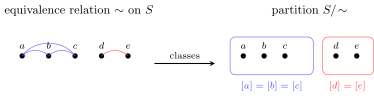
The Fundamental Theorem as a dictionary. On the left, ∼ links a,b,c together and d,e together; on the right, those links become the cells of a partition of S. Theorems 2 and 3 say the two pictures carry exactly the same information.
Corollary 4. Equivalence relations on S and partitions of S are in one-to-one correspondence: passing to classes and passing to “same-cell” are inverse operations.
Proof. Theorem 2 sends each relation to a partition; Theorem 3 sends each partition to a relation and shows its classes are the original cells. Running the two constructions in either order returns the object you started with, so each is the inverse of the other. ◻
Homework
-
For each relation on Z, say which of reflexive/symmetric/transitive hold, and whether it is an equivalence relation: (a) aRb⇔a−b is even; (b) aRb⇔ab≥0; (c) aRb⇔a=b or a=−b.
-
For ≡(mod5) on Z, list the equivalence class [2] (give five elements) and state how many distinct classes there are.
-
On S={1,2,3,4,5,6}, the partition {{1,4},{2,3,5},{6}} defines an equivalence relation by Theorem 3. Write [3] and [6], and decide: is 2∼4?
-
Define ∼ on R by x∼y⇔x−y∈Z. Prove ∼ is an equivalence relation, and describe [0] and [21].
-
Prove or disprove: if R is symmetric and transitive on S, then R is reflexive. (Where does the “proof” break?)
Suggested textbook exercises (Chartrand §9.2–9.3): 9.14, 9.16, 9.20, 9.24, 9.28, 9.32.