MATH 308 — Lec 8 — Proofs with Reals & Sets
Math 308 · October 7, 2026
Lecture 8 — Proofs about Real Numbers and Sets
MATH 308 Bridge to Advanced Mathematics Chartrand §4.3–4.5
Goals for today. By the end of this lecture you should be able to:
-
prove inequalities about real numbers by starting from a square that is ≥0 and rearranging;
-
use the absolute value ∣x∣ as “distance from 0” and prove the triangle inequality;
-
prove a containment A⊆B by the element method — the “for all x, x∈A⇒x∈B” template from Lecture 1;
-
prove a set equality by double containment, and establish identities like the distributive law A∩(B∪C)=(A∩B)∪(A∩C).
Proofs involving real numbers (§4.3)
We now prove statements, not just compute. The engine for real-number inequalities is one modest fact: a square is never negative. For every real t,
t2≥0,with t2=0 exactly when t=0.Almost every inequality below is this fact, wearing a disguise. We also use the order rules you already trust: you may add the same quantity to both sides, and you may multiply both sides by a positive number, without flipping “≤”.
Example 1. If x∈R and 0<x<1, then x2<x.
Proof. We are given x>0 and x<1. Multiply the inequality x<1 on both sides by the positive number x; since x>0 this preserves the direction:
x⋅x<1⋅x,that isx2<x.□Notice the shape of the argument: we started from what we were given and pushed forward to what we wanted. That is a direct proof (Lecture 5).
Proposition 1. For all real numbers a and b, ab≤2a2+b2.
Proof. Let a,b∈R be arbitrary. Since (a−b)2≥0, expanding gives
a2−2ab+b2≥0.Add 2ab to both sides: a2+b2≥2ab. Dividing by 2>0 preserves the inequality, so ab≤2a2+b2, as claimed. ◻
Remark 1. Read Proposition 1 backwards to see the strategy: the thing we wanted, a2+b2≥2ab, is equivalent to (a−b)2≥0, which is obviously true. In your scratch work you may reason from the goal down to something known; in the written proof you reverse the steps so each line follows from the previous one. Never present the scratch direction as the proof.
Absolute value as distance
Definition 1. For x∈R, the absolute value of x is
∣x∣={x,−x,x≥0,x<0.Geometrically ∣x∣ is the distance from x to 0 on the number line, and ∣x−y∣ is the distance between x and y.

∣x∣ is the distance from x to 0; ∣x−y∣ is the distance between x and y.
The single most useful fact about absolute value is the “sandwich” characterization.
Lemma 2. Let a∈R and let b≥0. Then ∣a∣≤b if and only if −b≤a≤b.
Proof. (⇒) Suppose ∣a∣≤b. If a≥0 then a=∣a∣≤b, and also a≥0≥−b. If a<0 then −a=∣a∣≤b, so a≥−b, and also a<0≤b. Either way −b≤a≤b.
(⇐) Suppose −b≤a≤b. If a≥0 then ∣a∣=a≤b. If a<0 then ∣a∣=−a≤b (multiply a≥−b by −1, flipping the inequality). Either way ∣a∣≤b. ◻
Theorem 3 (Triangle inequality). For all real numbers x and y, ∣x+y∣≤∣x∣+∣y∣.
Proof. Let x,y∈R. Applying Lemma 2 to a=x, b=∣x∣ (and to y) gives
−∣x∣≤x≤∣x∣,−∣y∣≤y≤∣y∣.Adding these two chains term by term,
−(∣x∣+∣y∣)≤x+y≤∣x∣+∣y∣.Now apply Lemma 2 in the other direction, with a=x+y and b=∣x∣+∣y∣≥0: the double inequality above is exactly the statement ∣x+y∣≤∣x∣+∣y∣. ◻
The name comes from geometry: the length of one side of a triangle never exceeds the sum of the other two. We will lean on Theorem 3 constantly when we make “closeness” precise with limits (Lectures 20–21).
Proofs involving sets (§4.4)
Recall the template from Lecture 1, the one we called the pattern for nearly every proof this term:
A⊆B⟺for every x, x∈A⇒x∈B.To prove A⊆B we therefore run the element method: take an arbitrary x∈A, and argue that x∈B. The word “arbitrary” is doing the work of the “for all.”
Proposition 4. For all sets A and B, A∩B⊆A.
Proof. Let x∈A∩B be arbitrary. By the definition of intersection, x∈A and x∈B. In particular x∈A. Since x was an arbitrary element of A∩B, we conclude A∩B⊆A. ◻
To prove an equality A=B, recall (Lecture 1) that A=B means A⊆B and B⊆A. So we prove it in two halves. This is the double-containment method, and it is the workhorse of the whole subject.
Theorem 5 (Distributive law). For all sets A,B,C, A∩(B∪C)=(A∩B)∪(A∩C).
Proof. We prove the two containments separately.
(⊆) A∩(B∪C)⊆(A∩B)∪(A∩C). Let x∈A∩(B∪C) be arbitrary. Then x∈A, and x∈B∪C, i.e. x∈B or x∈C. We consider the two cases.
-
If x∈B: then x∈A and x∈B, so x∈A∩B, hence x∈(A∩B)∪(A∩C).
-
If x∈C: then x∈A and x∈C, so x∈A∩C, hence x∈(A∩B)∪(A∩C).
In either case x∈(A∩B)∪(A∩C), which proves this containment.
(⊇) (A∩B)∪(A∩C)⊆A∩(B∪C). Let x∈(A∩B)∪(A∩C) be arbitrary. Then x∈A∩B or x∈A∩C.
-
If x∈A∩B: then x∈A and x∈B; since x∈B we have x∈B∪C, so x∈A∩(B∪C).
-
If x∈A∩C: then x∈A and x∈C; since x∈C we have x∈B∪C, so x∈A∩(B∪C).
In either case x∈A∩(B∪C), which proves this containment.
Having shown both containments, A∩(B∪C)=(A∩B)∪(A∩C). ◻
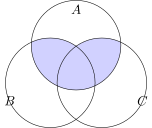
The shaded region is A∩(B∪C): the part of A lying in B or in C. It coincides with (A∩B)∪(A∩C) — the picture and the proof agree.
Remark 2. A picture like this is a wonderful guide, but it is not a proof: a Venn diagram cannot certify a statement about all sets, and diagrams for four or more sets stop being trustworthy. The double-containment argument does what the picture cannot.
The same method proves the companion identities. As a second, cleaner example we prove one of De Morgan’s laws — promised (unproven) back in Lecture 1.
Proposition 6 (A De Morgan law). Let A,B⊆U. Then (A∪B)c=Ac∩Bc.
Proof. Let x∈U be arbitrary; we show x lies in the left side iff it lies in the right side.
x∈(A∪B)c⇔x∈/A∪B⇔(x∈/A and x∈/B)⇔(x∈Ac and x∈Bc)⇔x∈Ac∩Bc.Since each step is an “if and only if,” an element belongs to one side exactly when it belongs to the other, so the sets are equal. ◻
Remark 3. Proposition 6 shows a second flavor of the element method: instead of two separate containments, we chain iffs so both directions are handled at once. Use double containment when the two directions need different arguments; use the iff-chain when every step reverses cleanly. (Recall from Lecture 1 that we write the complement as Ac, reserving the overline for the closure of a set of reals, Lecture 21.)
Homework problems
-
Prove: for all real numbers a,b, if 0≤a≤b then a2≤b2. (Where do you use a≥0?)
-
Prove: for every real number x, x2+1≥2∣x∣. (Hint: start from (∣x∣−1)2≥0.)
-
Use the element method to prove A−B⊆A for all sets A,B.
-
Prove by double containment the other distributive law: A∪(B∩C)=(A∪B)∩(A∪C).
-
Prove the second De Morgan law (A∩B)c=Ac∪Bc, either by double containment or by an iff-chain.
-
True or false, with a one-line reason: if A⊆B then A∩C⊆B∩C for every set C.
Suggested textbook exercises (Chartrand §4.3–4.5): 4.30, 4.34, 4.40, 4.48, 4.54, 4.60, 4.66.