MATH 308 — Lec 12 — Strong Induction
Math 308 · October 15, 2026
Lecture 12 — Strong Induction and Reviewing Proof Techniques
MATH 308 Bridge to Advanced Mathematics Chartrand §6.3–6.4 (+ Ch 7)
Goals for today. By the end of this lecture you should be able to:
-
state the Strong Principle of Mathematical Induction and recognize when ordinary induction is not enough;
-
prove that every integer n≥2 has a prime factorization, using strong induction;
-
state the Well-Ordering Principle and use a smallest-counterexample argument;
-
name and choose among all the proof techniques we have met so far (Ch 7 review).
From ordinary to strong induction (§6.3)
Recall the ordinary Principle of Mathematical Induction from Lecture 11: to prove P(n) for all n≥n0, we check the base case P(n0) and the inductive step P(k)⇒P(k+1). Each domino topples the next one, using only its immediate predecessor.
But some statements resist this. Consider: every integer n≥2 is a product of primes. If I know 12 factors as 2⋅2⋅3, that tells me nothing directly about 13. What actually helps is this: to factor n, either n is prime, or n=a⋅b with 2≤a,b<n — and I would like to assume the result already holds for those smaller numbers a and b, not just for n−1. We need all previous cases, not just the last one.
Theorem 1 (Strong Principle of Mathematical Induction). For each integer n≥n0, let P(n) be a statement. Suppose
-
(base case) P(n0) is true, and
-
(inductive step) for every integer k≥n0, the truth of all of P(n0),P(n0+1),…,P(k) implies P(k+1).
Then P(n) is true for every integer n≥n0.
The only change from ordinary induction is the hypothesis we are allowed in the step: not merely P(k), but the whole block P(n0)∧⋯∧P(k). This is called the strong (or complete) induction hypothesis. Anything provable by ordinary induction is provable by strong induction — you just may not need the extra assumptions.
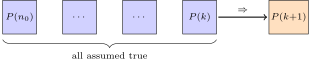
Strong induction: the step for P(k+1) may lean on every earlier case, not just P(k).
Theorem 2 (Existence of prime factorization). Every integer n≥2 can be written as a product of (one or more) prime numbers.
Proof. We use strong induction on n, with n0=2. Let P(n) be “n is a product of primes.”
Base case. P(2) holds, since 2 is itself prime (a single prime counts as a product of one prime).
Inductive step. Fix k≥2 and assume P(2),P(3),…,P(k) are all true; we prove P(k+1). There are two cases.
-
If k+1 is prime, then k+1 is already a product of one prime, so P(k+1) holds.
-
If k+1 is not prime, then by definition it is composite: k+1=a⋅b for some integers with 2≤a≤b<k+1, i.e. 2≤a,b≤k. By the strong hypothesis, P(a) and P(b) hold, so a=p1⋯pr and b=q1⋯qs with each pi,qj prime. Then
k+1=a⋅b=p1⋯prq1⋯qs,
a product of primes. Hence P(k+1) holds.
In both cases P(k+1) is true. By strong induction, P(n) holds for all n≥2. ◻
Remark 1. Ordinary induction fails here: knowing that k factors into primes says nothing about k+1 (compare k=11, prime, with k+1=12=22⋅3). The factorization of k+1 is controlled by its divisors a,b, which sit somewhere below k+1 — exactly the situation strong induction is built for. The matching uniqueness of the factorization (the Fundamental Theorem of Arithmetic) needs one more tool and waits for Lecture 15.
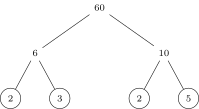
A factor tree for 60=6⋅10=2⋅3⋅2⋅5. Every branch shrinks the number, and the leaves (circled) are prime — the picture behind the strong-induction proof.
Example 1 (When “one step back” isn’t enough). Prove that every integer n≥12 can be written as n=4a+5b for some integers a,b≥0.
We induct strongly from n0=12, but the step will reach four places back, so we need four base cases:
12=4⋅3,13=4⋅2+5,14=4+5⋅2,15=5⋅3.Step. Fix k≥15, assume the claim for 12,…,k, and prove it for k+1. Since k+1≥16, the number (k+1)−4=k−3 satisfies 12≤k−3≤k, so by hypothesis k−3=4a+5b with a,b≥0. Then
k+1=(k−3)+4=4(a+1)+5b,which is again of the required form. By strong induction, the claim holds for all n≥12.
The Well-Ordering Principle
Strong induction has a twin, phrased not about building up but about going down as far as you can.
Theorem 3 (Well-Ordering Principle, WOP). Every nonempty subset of N has a least element. That is, if S⊆N and S=∅, then there is an m∈S with m≤x for all x∈S.
This is obvious for N (start at 1 and walk up until you first land in S) but false for Z, Q, and R: the set Z has no least element, and the open interval (0,1)⊆R has none either. Well-ordering is a special feature of the naturals, and it is logically equivalent to the two induction principles — each can be proved from the others.

Well-Ordering: any nonempty S⊆N, however scattered, has a smallest member.
WOP powers the smallest-counterexample method: to prove P(n) for all n, assume some counterexample exists, let m be the least n for which P(n) fails, and derive a contradiction — usually by producing a still-smaller failure. Here is the prime-factorization theorem again, now through WOP, so you can compare the two styles.
Proposition 4 (Prime factorization, via WOP). Every integer n≥2 is a product of primes.
Proof. Let S={n∈N:n≥2 and n is not a product of primes}. We claim S=∅. Suppose instead S=∅. By WOP, S has a least element m, and m≥2. Now m is not prime (a prime is a product of one prime, so it would not lie in S), hence m is composite: m=a⋅b with 2≤a,b<m. By minimality of m, neither a nor b is in S, so each is a product of primes; multiplying those factorizations exhibits m as a product of primes. This contradicts m∈S. Therefore S=∅, and every n≥2 is a product of primes. ◻
The two proofs are the same idea wearing different clothes: “assume all smaller cases work” (strong induction) versus “take the smallest that fails” (WOP). Choose whichever reads more cleanly for the problem in front of you.
Reviewing proof techniques (Ch 7)
We have now assembled the full toolkit. Chapter 7 asks you to step back and choose a technique rather than be handed one. The menu so far:
| Technique | Use it when… | Lecture |
|---|---|---|
| Direct proof | you can chain hypothesis ⇒ conclusion forward | 5 |
| Contrapositive | the negation of the conclusion is easier to start from | 5 |
| Proof by cases | the hypothesis splits into exhaustive alternatives (e.g. even/odd) | 6 |
| Biconditional | you must prove “⇔”: prove each direction separately | 6 |
| Contradiction | assuming “true and not-conclusion” forces an absurdity | 9 |
| Existence | you must produce an object (construct one, or argue it must exist) | 9 |
| Counterexample | you disprove a “for all” by exhibiting one failure | 10 |
| Uniqueness | “at most one”: assume two such objects and show they are equal | 10 |
| Induction | a statement P(n) for all n≥n0; each case builds on the last | 11 |
| Strong induction / WOP | each case needs all smaller cases, or a smallest offender | 12 |
Remark 2 (A decision habit). Read the statement’s shape first. “For all n” with a natural-number index ⇒ suspect induction. “For all x, if P then Q” ⇒ try direct, then contrapositive. “There exists” ⇒ construct. “There is a unique” ⇒ existence plus a uniqueness argument. A “for all” you doubt ⇒ hunt for a counterexample before proving. And “no such thing exists” ⇒ contradiction or infinite descent. The technique is dictated by the logical form, which is why Lectures 3–4 (logic) underwrite everything here.
Homework problems
-
Where exactly does the prime-factorization proof use that a,b<k+1? What would break if we only knew a,b≤k+1?
-
Define f1=1, f2=1, and fn=fn−1+fn−2 for n≥3 (the Fibonacci numbers). Prove by strong induction that fn<2n for all n≥1. Why do you need two previous cases (and two base cases)?
-
Prove that every integer n≥8 can be written as n=3a+5b with a,b≥0. How many base cases do you need, and why?
-
Use the Well-Ordering Principle to prove there is no integer strictly between 0 and 1. (Hint: a smallest such integer would have a smaller square.)
-
For each claim, name the technique you would use and give the first line of the proof (no full proof needed): (a) “2 is irrational”; (b) “if n2 is even then n is even”; (c) “some prime is one more than a perfect square”; (d) “every n≥1 satisfies 1+2+⋯+n=2n(n+1).”
Suggested textbook exercises (Chartrand §6.3–6.4 (+ Ch 7)): 6.30, 6.34, 6.38, 6.42, 6.46, and Ch 7 review 7.4, 7.10, 7.16.