MATH 308 — Lec 4 — Logic II (Quantifiers)
Math 308 · September 18, 2026
Lecture 4 — Logic II: Quantifiers
MATH 308 Bridge to Advanced Mathematics Chartrand §2.10
Goals for today. By the end of this lecture you should be able to:
-
read and write statements with the universal quantifier ∀ (“for all”) and the existential quantifier ∃ (“there exists”) over a stated domain;
-
decide whether a quantified statement is true or false — by a witness for ∃, and by ruling out counterexamples for ∀;
-
negate a quantified statement, turning ∀ into ∃ and ∃ into ∀;
-
handle statements with mixed quantifiers and explain why the order ∀∃ versus ∃∀ changes the meaning.
Open sentences and the two quantifiers (§2.10)
Recall from Lecture 3 that a statement is a sentence that is either true or false. A sentence like
P(x):x2≥0is not yet a statement — its truth depends on the value of x. We call P(x) an open sentence (or predicate) over a domain S: for each specific x∈S it becomes a genuine statement. There are two standard ways to turn an open sentence into a single statement, by attaching a quantifier.
Definition 1 (Universal quantifier). Let P(x) be an open sentence over a domain S. The universal quantifier ∀ (“for every,” “for all,” “for each”) produces the statement
∀x∈S, P(x)read“for every x∈S, P(x).”It is true if P(x) is true for every x∈S, and false if P(x) fails for at least one x∈S.
Definition 2 (Existential quantifier). The existential quantifier ∃ (“there exists,” “there is,” “for some,” “for at least one”) produces the statement
∃x∈S, P(x)read“there exists x∈S such that P(x).”It is true if P(x) is true for at least one x∈S, and false if P(x) fails for every x∈S.
Remark 1. The domain is part of the statement, never optional. “∀x, x2≥0” is true over R; the same words over the domain of 2×2 matrices would need a new definition of “≥0.” Whenever you write ∀ or ∃, say over what.
Example 1. Take P(x):x2≥0 over R. Then ∀x∈R, x2≥0 is true: the square of every real number is nonnegative. Three equivalent phrasings, all common in proofs:
“For every real x, x2≥0,”“If x∈R, then x2≥0,”“The square of every real number is nonnegative.”Notice that “∀x∈S, P(x)” is exactly an implication “if x∈S then P(x)” — the “for all” hiding behind every subset claim (Lecture 1) and every direct proof (Lecture 5).
Example 2. Let Q(n):n is prime over S={1,2,…,7}.
-
∀n∈S, Q(n) is false: Q(4) fails, since 4 is not prime. A single bad n sinks a “for all.”
-
∃n∈S, Q(n) is true: Q(2) holds, since 2 is prime. A single good n confirms a “there exists.”
This asymmetry is the whole game: to prove ∃, exhibit one witness; to disprove ∀, exhibit one counterexample (we build the counterexample method into Lecture 10).
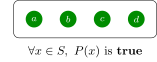
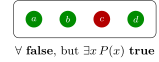
A domain S={a,b,c,d}. Green = P holds, red = P fails. Left: P holds everywhere, so ∀xP(x) is true. Right: the single red element c is a counterexample that makes ∀xP(x) false — yet ∃xP(x) is still true, witnessed by any green element.
Negating quantified statements (§2.10)
The most useful skill in this lecture is negation. To disprove a “for all” or to run a proof by contradiction (Lecture 9), you must state the negation cleanly. The rule is a pair of mirror images.
Proposition 1 (The negation rules). *For an open sentence P(x) over a domain S,
∼(∀x∈S, P(x))≡∃x∈S, ∼P(x),∼(∃x∈S, P(x))≡∀x∈S, ∼P(x).In words: the negation of “all are” is “some is not”; the negation of “some is” is “all are not.”*
Proof. Consider the first equivalence. By definition, ∀x∈S, P(x) is false exactly when P(x) fails for at least one x∈S — that is, exactly when ∃x∈S, ∼P(x) is true. So the two statements ∼(∀x∈S,P(x)) and ∃x∈S,∼P(x) have the same truth value in every case, hence are logically equivalent (Lecture 3). The second equivalence is proved the same way, or obtained from the first by negating both sides and relabelling P as ∼P. ◻
Example 3. Negate “∀x∈R, x2>0.” The negation is
∃x∈R, x2≤0.The original is false (take x=0), so the negation is true — and indeed x=0 is the witness. This is exactly how a counterexample works: the counterexample to a false ∀ is the witness for its true ∃-negation.
Example 4 (Negation with an implication inside). Recall from Lecture 3 that ∼(P⇒Q)≡P∧∼Q. Combine this with the quantifier rule to negate
∀n∈Z, (n is even⇒n2 is even).Pushing the negation inward:
∼(∀n∈Z, (n even⇒n2 even))≡∃n∈Z, (n is even ∧ n2 is odd).The original statement is true (we will prove it directly in Lecture 5), so this negation is false: there is no even integer whose square is odd.
Mixed quantifiers, and why order matters (§2.10)
Open sentences can involve two variables, P(x,y), each with its own domain, and we may quantify each. Quantifiers of the same type commute: ∀x∀yP(x,y) says the same thing as ∀y∀xP(x,y), and likewise for two ∃’s. But a ∀ and an ∃ do not commute — swapping them can change a true statement into a false one.
Example 5 (∀∃ versus ∃∀). Let P(x,y):x+y=0 over the reals. Compare:
(A)∀x∈R, ∃y∈R, x+y=0,(B)∃y∈R, ∀x∈R, x+y=0.Statement (A) is true. Read it left to right: first an x is handed to us, then we choose y — and our choice may depend on x. Given x, take y=−x; then x+y=0. Every x has its own private y.
Statement (B) is false. Now a single y must be chosen first, and it must work for every x. No fixed y can satisfy x+y=0 for all x: if it worked for x=0 then y=0, but then x=1 gives 1+0=1=0.
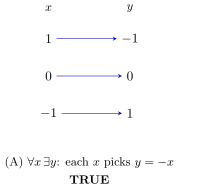
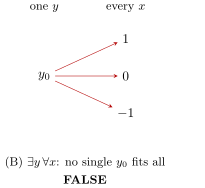
Order is everything. In (A) we choose y after seeing x, so y may adapt (y=−x). In (B) one y0 is fixed before any x appears and must serve them all at once — impossible here.
Proposition 2. The statement ∀x∈R, ∃y∈R, x+y=0 is true, but ∃y∈R, ∀x∈R, x+y=0 is false.
Proof. First statement. Let x∈R be arbitrary. Put y=−x∈R. Then x+y=x+(−x)=0, so P(x,y) holds. Since x was arbitrary, ∃y, x+y=0 holds for every x, which is the claim.
Second statement. We show its negation is true; by the negation rules,
∼(∃y∈R, ∀x∈R, x+y=0)≡∀y∈R, ∃x∈R, x+y=0.Let y∈R be arbitrary. Choose x=1−y∈R. Then x+y=(1−y)+y=1=0. So for every y some x breaks the equation, the negation is true, and the original is false. ◻
Remark 2. A reliable reading rule: a later quantifier lives “inside” the earlier ones and may depend on them. In ∀x∃y, the y may be a function of x; in ∃y∀x, the y is locked in first. This single idea is what the entire ε–δ machinery of calculus turns on — see the box below and Lectures 20–21.
| Density on the line: |  |
Homework Problems
-
For each statement, say whether it is true or false and give a one-line reason (a witness or a counterexample): (a) ∀n∈N, n2≥n; (b) ∃n∈Z, n2=2; (c) ∀x∈R, ∃y∈R, y2=x.
-
Write the negation of each, pushing ∼ all the way in: (a) ∀x∈R, (x>0⇒x2>0); (b) ∃n∈N, n is prime and n is even.
-
Translate to symbols with domains, then decide truth: “Every integer has an additive inverse” and “There is an integer that is an additive inverse of every integer.” Which is which of ∀∃ / ∃∀?
-
Let P(x,y):x<y over R. Decide the truth of ∀x∃yP(x,y) and of ∃y∀xP(x,y), and justify each with the reading rule “later quantifier may depend on earlier.”
-
Negate the limit statement: write limx→af(x)=L as a fully quantified sentence with no ∼ in front of any quantifier.
Suggested textbook exercises (Chartrand §2.10): 2.68, 2.72, 2.76, 2.80, 2.84, 2.90.