MATH 308 — Lec 19 — Uncountability; Cantor
Math 308 · November 14, 2026
Lecture 19 — Uncountable Sets: Cantor and Schröder–Bernstein
MATH 308 Bridge to Advanced Mathematics Chartrand §11.3–11.5
Goals for today. By the end of this lecture you should be able to:
-
state what it means for a set to be uncountable, and prove R is uncountable by Cantor’s diagonal argument;
-
prove Cantor’s theorem ∣A∣<∣P(A)∣ for every set A;
-
state the Schröder–Bernstein theorem and use it to prove two sets have equal cardinality;
-
explain why there is an unending hierarchy of larger and larger infinities.
Countable vs. uncountable (§11.3)
Recall from Lecture 18 the vocabulary for comparing sizes. For sets A,B we write ∣A∣≤∣B∣ if there is an injection A→B, and ∣A∣=∣B∣ if there is a bijection A→B (Lecture 16). A set A is denumerable (countably infinite) if ∣A∣=∣N∣, and countable if it is finite or denumerable. We showed Z and Q are countable.
Definition 1. A set A is uncountable if it is infinite but not countable — that is, there is no bijection N→A (equivalently, no way to list its elements as a1,a2,a3,… so that every element appears).
To prove a set is uncountable we must rule out every possible list. The tool for this is a proof by contradiction (Lecture 9): assume a complete list exists, then manufacture an element the list missed.
Theorem 1 (Cantor, 1891). The interval (0,1) is uncountable. Consequently R is uncountable.
Proof. Suppose, for contradiction, that (0,1) is countable. Being infinite, it would then be denumerable, so we could list all of its elements as x1,x2,x3,…. Write each xi by its decimal expansion,
xi=0.di1di2di3di4⋯,dij∈{0,1,…,9},choosing the non-terminating form when there is a choice (e.g. 0.49 rather than 0.50), so each number has one representative.
Now build a new number y=0.c1c2c3⋯ by walking down the diagonal d11,d22,d33,… and changing every digit:
ci={5,4,dii=5,dii=5.Then y∈(0,1), and every digit of y is a 4 or a 5, so y never terminates and never ends in all 9’s — it is its own unique representative. But y differs from xi in the i-th decimal place (by construction ci=dii), so y=xi for every i. Thus y is an element of (0,1) that appears nowhere on the list — contradicting that the list was complete.
Hence (0,1) is uncountable. Since (0,1)⊆R and a subset of a countable set is countable, R cannot be countable either. ◻
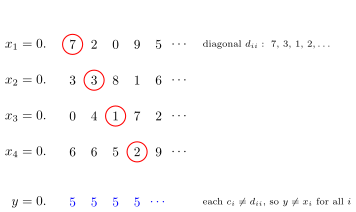
Cantor’s diagonal argument. Whatever list x1,x2,… is proposed, the number y built off the circled diagonal disagrees with row i in column i, so it is on no row.
Remark 1. The same idea shows the set of all infinite binary strings {0,1}N is uncountable: flip the i-th bit of the i-th string. Diagonalization is one argument, reused.
Cantor’s theorem: P(A) is always bigger (§11.4)
Diagonalization is not special to decimals. It shows that no set can be put in bijection with its own power set (Lecture 1: P(A)={X:X⊆A}).
Theorem 2 (Cantor). For every set A, ∣A∣<∣P(A)∣.
Proof. First ∣A∣≤∣P(A)∣: the map a↦{a} is an injection A→P(A).
It remains to show ∣A∣=∣P(A)∣, i.e. that no function f:A→P(A) is surjective (so none is a bijection). Let f:A→P(A) be any function. Each f(a) is a subset of A, so for a given a the question “is a∈f(a)?” makes sense. Collect the elements that answer no:
D={a∈A:a∈/f(a)} ∈ P(A).We claim D is not in the image of f. Suppose D=f(a0) for some a0∈A, and ask whether a0∈D:
a0∈D⇔a0∈/f(a0)⇔a0∈/D,using the definition of D and then D=f(a0). This says a0∈D⇔a0∈/D, a contradiction. So no such a0 exists: D has no preimage, f is not surjective. Since f was arbitrary, there is no bijection A→P(A). ◻
The set D is the diagonal in disguise: if we tabulate “a∈f(b)?” in a grid with rows and columns indexed by A, then D is built by flipping the diagonal entries a∈f(a).
Example 1. Taking A=N: ∣N∣<∣P(N)∣, so P(N) is uncountable. A subset of N corresponds to an infinite 0/1 string (bit i says whether i∈ the subset), matching the Remark above.
Corollary 3. *There is no largest infinity. Iterating,
∣N∣ < ∣P(N)∣ < ∣P(P(N))∣ < ⋯is a strictly increasing tower of infinite cardinalities that never stops.*
The Schröder–Bernstein theorem
To prove ∣A∣=∣B∣ we have needed an explicit bijection — often hard to write down. The next theorem lets us build one from two injections, one in each direction, which are usually far easier to find.
Theorem 4 (Schröder–Bernstein). *Let A,B be sets. If there is an injection f:A→B and an injection g:B→A, then there is a bijection A→B. In cardinal shorthand:
∣A∣≤∣B∣ and ∣B∣≤∣A∣ ⟹ ∣A∣=∣B∣.We will not prove the theorem in full (the standard proof partitions A∪B into “chains” generated by alternately applying f and g, and flips direction on each chain). What matters for us is that it makes cardinal comparison behave like the ordering ≤ on numbers: if each side is “≤” the other, they are equal.
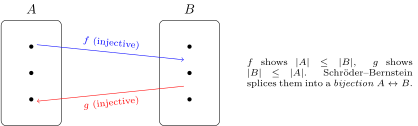
Two injections in opposite directions force a bijection — no explicit formula required.
Example 2 (∣(0,1)∣=∣[0,1]∣). An explicit bijection between the open and closed interval is fiddly; two injections are trivial.
-
f:(0,1)→[0,1], f(x)=x, is an injection (it is the inclusion).
-
g:[0,1]→(0,1), g(x)=41+2x, sends [0,1] into [41,43]⊆(0,1) and is injective (it is linear).
By Schröder–Bernstein, ∣(0,1)∣=∣[0,1]∣: the endpoints do not change the cardinality.
Example 3 (The continuum: ∣R∣=∣P(N)∣). The map x↦1+e−x1 is a bijection R→(0,1), so ∣R∣=∣(0,1)∣. Reading a number in (0,1) by its binary expansion gives (essentially) an infinite 0/1 string, i.e. a subset of N; two injections plus Schröder–Bernstein clean up the ambiguous dual expansions to yield ∣(0,1)∣=∣P(N)∣. Combining, ∣R∣=∣P(N)∣. This common cardinality is called the continuum, written c=2ℵ0, and by Cantor’s theorem it is strictly larger than ∣N∣=ℵ0.
Historical note
Georg Cantor introduced these ideas in the 1870s–1890s, founding set theory almost single-handedly. His 1874 paper already showed R is uncountable; the clean diagonal argument of Theorem 1 came in 1891, packaged together with the general Theorem 2. The results were radical — an actual, completed infinity, and many infinities — and drew fierce opposition, most famously from Leopold Kronecker, who blocked Cantor’s career. Vindication came quickly: David Hilbert called Cantor’s paradise “no one shall expel us from,” and made the Continuum Hypothesis the first of his 23 problems in 1900. The theorem of §3 was proved independently by Felix Bernstein (a student of Cantor) and Ernst Schröder around 1897; Cantor and Dedekind had it earlier but unpublished — hence you will also see it called the Cantor–Bernstein or Cantor–Schröder–Bernstein theorem.
Homework problems
-
Run the diagonal argument on the list x1=0.123…, x2=0.456…, x3=0.789… (underlined = diagonal). Using the rule ci=5 if dii=5 else 4, write the first three digits of a number y not on the list.
-
Explain in one sentence why the diagonal argument does not show Q is uncountable. (What goes wrong if you try to run it on a list of rationals?)
-
Let A={1,2} and let f:A→P(A) be f(1)={1,2}, f(2)=∅. Compute the “diagonal” set D={a:a∈/f(a)} and verify D=f(1) and D=f(2).
-
Use Schröder–Bernstein to prove ∣N∣=∣N×N∣ by giving one injection each way. (Hint: n↦(n,1); and (a,b)↦2a3b.)
-
Give injections both ways to show ∣[0,1]∣=∣[0,1]×[0,1]∣ is at least plausible — which direction is the easy inclusion, and which needs an idea?
-
True/false with a one-line reason: (a) every subset of an uncountable set is uncountable; (b) ∣P(N)∣=∣R∣; (c) there is a set A with ∣A∣=∣P(A)∣.
Suggested textbook exercises (Chartrand §11.3–11.4): 11.28, 11.30, 11.34, 11.38, 11.42, 11.46.