MATH 308 — Lec 2 — Sets II (Indexed Families, Partitions, Cartesian Products)
Math 308 · September 4, 2026
Lecture 2 — Sets II: Indexed Families, Partitions, Cartesian Products
MATH 308 Bridge to Advanced Mathematics Chartrand §1.4–1.6
Goals for today. By the end of this lecture you should be able to:
-
read an indexed family {Aα}α∈I and compute ⋃α∈IAα and ⋂α∈IAα;
-
check whether a collection of subsets is a partition of a set;
-
form the Cartesian product A×B, list its elements, and count them.
Indexed collections of sets (§1.4)
Often we have not two or three sets but a whole family of them, one for each element of an index set I. We write {Aα}α∈I (read “the sets Aα, as α ranges over I”). Union and intersection extend naturally:
α∈I⋃Aα={x:x∈Aα for some α∈I},α∈I⋂Aα={x:x∈Aα for every α∈I}.Notice the quiet appearance of some and every — exactly the quantifiers we take up next week.
Example 1. Let An=[0,n1] for each n∈N. Every An contains 0, and as n grows the intervals shrink toward {0}:
n∈N⋃An=[0,1],n∈N⋂An={0}.The intersection is not empty: 0 lies in every An; but no positive number does, since n1→0.
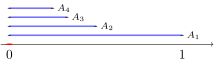
The nested intervals An=[0,n1] (top to bottom: A1,A2,A3,A4). Only 0 survives every one: ⋂nAn={0}.
Partitions of a set (§1.5)
Definition 1. A partition of a nonempty set S is a collection P of nonempty subsets of S such that
-
every element of S lies in some member of P (the members cover S), and
-
distinct members are disjoint (any two members are equal or share no element).
Equivalently: each element of S lies in exactly one member. The members are called the cells (or blocks) of the partition.
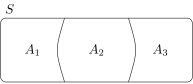
A partition of S into three cells: they cover S and are pairwise disjoint.
Example 2. The sets E={n∈Z:n even} and O={n∈Z:n odd} form a partition {E,O} of Z: every integer is even or odd (cover), and none is both (disjoint). This is the seed of an equivalence relation — “same parity” — which we develop in Lecture 14.
Cartesian products (§1.6)
Definition 2. The Cartesian product of sets A and B is the set of ordered pairs
A×B={(a,b):a∈A and b∈B}.Order matters: (a,b)=(c,d) means a=c and b=d. If A,B are finite then ∣A×B∣=∣A∣⋅∣B∣.
Example 3. With A={1,2,3} and B={a,b},
A×B={(1,a),(1,b),(2,a),(2,b),(3,a),(3,b)},∣A×B∣=3⋅2=6.The most important instance is R×R=R2, the coordinate plane: a point is an ordered pair (x,y).
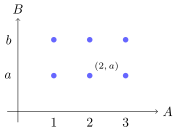
{1,2,3}×{a,b} as a grid of 6 ordered pairs.
Homework problems
-
Let An={k∈N:k≥n} for n∈N. Find ⋃nAn and ⋂nAn.
-
Is {{1,2},{2,3},{3}} a partition of {1,2,3}? If not, which condition fails?
-
Give a partition of Z into three cells. (Hint: remainders on division by 3.)
-
List A×B and B×A for A={0,1}, B={x,y}. Is A×B=B×A?
-
If ∣A∣=4 and ∣B∣=3, how many elements does A×B have? How many subsets does it have?
-
If A, B, C are sets, show that (A−B)×C=(A×C)−(B×C).
-
Let I be a nonempty set and for each i∈I let Xi be a set. Prove that
-
for any set B, B∩i∈I⋃Xi=i∈I⋃(B∩Xi);
-
if each Xi is a subset of a given set S, then (i∈I⋃Xi)c=i∈I⋂Xic.
-
Suggested textbook exercises (Chartrand §1.4–1.6): 1.40, 1.46, 1.54, 1.60, 1.66, 1.72.